
 LOCATION:
Home
-
News & Information
-
News
-
Content
LOCATION:
Home
-
News & Information
-
News
-
Content
The pen was set down, and applause broke out. On August 19, 2024, the Yueyang Municipal People’s Government and Hunan Institute of Science and Technology (HNIST) held a signing ceremony for a strategic development cooperation framework agreement.
The framework agreement focuses on two main themes: the transformation and upgrading of traditional industries and the cultivation and development of new quality productive forces. Leveraging HNIST’s strengths in education, technology, talent, innovation, as well as its role in demonstration, leadership, resource sharing, and spillover effects, the agreement aims to build a new model of industry-education integration and science-education convergence. It focuses on solving a number of common key technological problems in industry development, achieving the transformation of a series of major results to promote industrial revitalization, inheriting and innovating local excellent traditional culture, continuously advancing the integrated development of culture and tourism in Yueyang, enhancing the city’s soft power, and highlighting its distinctive character.
In recent years, HNIST has targeted the full-chain petrochemical industry in Hunan, aligning its disciplinary chains with industrial chains to serve major regional industrial needs and transformation and upgrading requirements, promote the integration of industry, academia, and research, and overcome the "last mile" challenge in translating research results into practical applications.
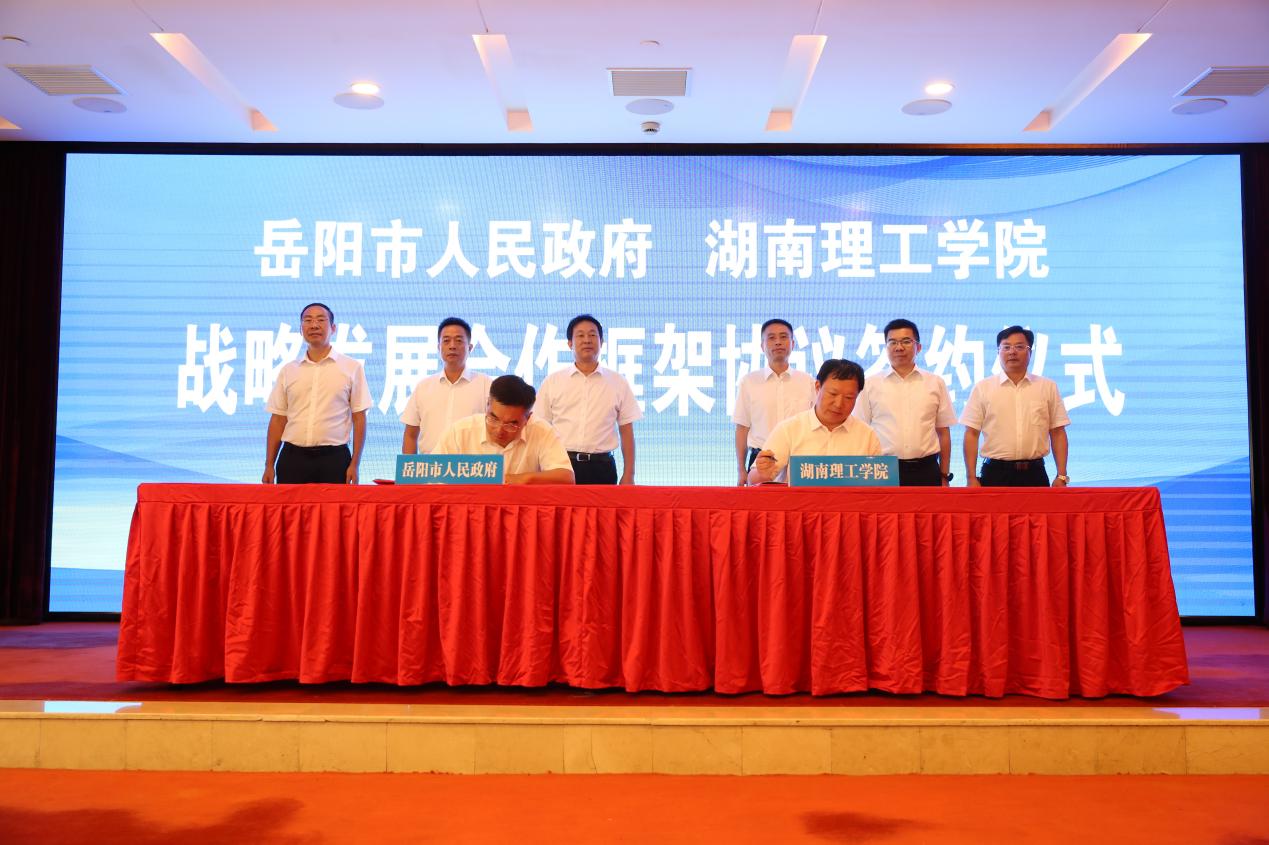
Hunan Institute of Science and Technology signs a strategic development cooperation framework agreement with the Yueyang Municipal People’s Government.
Universities and Enterprises "Advancing Together"
"My work itself is conducting 'chemical experiments'—connecting the needs of the petrochemical industry chain with faculty members’ strong research projects, allowing them to produce a 'chemical reaction' until the projects are industrialized." As a full-time teacher at HNIST and currently the deputy director of the Hunan Modern Petrochemical Industry Collaborative Innovation Research Institute, Zhou Quan serves as a "liaison officer" between the university, the local government, and enterprises.
In May 2023, the Hunan Modern Petrochemical Collaborative Innovation Research Institute was officially inaugurated. Established by HNIST in collaboration with several universities and research institutions, it centers on the core base of the modern trillion-yuan petrochemical industry cluster in Yueyang Green Chemical High-Tech Zone. It operates a "five-in-one" model for transforming scientific and technological achievements with professional characteristics: "Research Institute + Research Institute Co., Ltd. + Fund + Base + Industry Alliance," serving as an integrated platform for technology development, pilot testing, and results transformation.
Currently, the provincial party committee and government are accelerating the construction of a "4×4" modern industrial system, listing modern petrochemicals as a key industry for development. The Seventh Plenary Session of the Eighth Yueyang Municipal Party Committee proposed transforming and upgrading the traditional modern petrochemical industry, promoting its development toward "high-end, intelligent, green, and integrated" goals, aiming to create a world-leading green high-end chemical and new materials industrial agglomeration zone, among three demonstration zones.
Against this development backdrop, HNIST has continuously strengthened its awareness of social service, taking the chemical engineering discipline as a breakthrough to solidly serve local industrial development. In June 2024, HNIST organized a service matchmaking meeting for Yueyang’s modern petrochemical and new materials industry. Attendees included top talents from the city’s petrochemical industry in science and technology fields. Doctoral professors from various disciplines engaged in face-to-face exchanges with representatives from industrial parks and enterprises, conducting "brainstorming" sessions on how advantageous disciplines can support the development of the modern petrochemical industry. They explored new models and pathways for government-industry-academia-research integration, deepening exchanges and cooperation between the university, local government, and enterprises, and promoting the transformation of scientific research results.
In recent years, Yueyang Green Chemical High-Tech Zone and its enterprises have strengthened cooperation with research institutions, increased efforts to transform scientific and technological achievements, and formed a green petrochemical industry cluster. Yueyang Green Chemical High-Tech Zone has been included in the province’s key development and cultivation plan for trillion-yuan petrochemical industry clusters, ranking among the "Top 30 Chemical Parks in China."
"The university will continue to focus on the needs of regional industrial transformation and upgrading, strengthening traditional advantageous disciplines, optimizing characteristic disciplines, refining disciplines that meet strategic demands, and planning emerging disciplines," emphasized Zhang Guoyun, Secretary of the Party Committee of HNIST. "Only by deeply integrating the university’s disciplinary and talent advantages with local industrial and regional advantages can we effectively address local talent and technological needs."
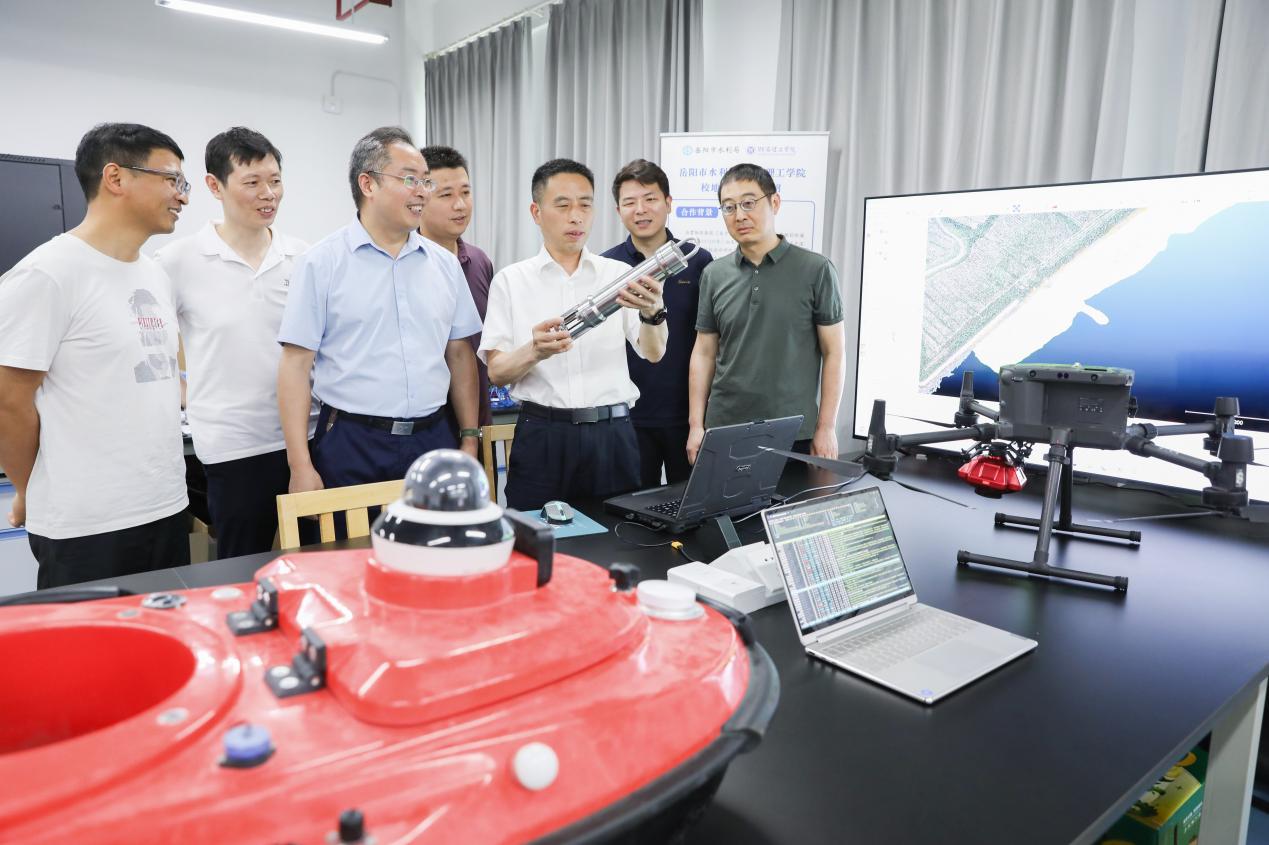
Zhang Guoyun, Secretary of the Party Committee of the university, and his team discuss how to contribute technological strength to "protecting the clear waters of the river."
"Practical Application" in Talent Cultivation
"Protecting the clear waters of the river requires the joint efforts of all parties." As the leader of the "Intelligent Image Processing and Applications" scientific and technological innovation team of Hunan provincial universities, Zhang Guoyun gazed at the clear river water and remarked.
In the past, due to technical limitations, monitoring underwater embankments in the Dongting Lake area was often neglected. To tackle this challenge, HNIST, along with the Yueyang Water Resources Bureau and other units, organized multiple riverside seminars and on-site demonstrations, establishing the "Smart Water Safety Engineering Research Center." This center has developed a distinctive research focus on intelligent and informational ecological protection of the Dongting Lake and Yangtze River shoreline, producing a series of scientific research achievements such as rapid thermal infrared detection for levee safety.
One expert leads one team to serve one project—this is the exploration of HNIST’s scientific research "Three-One Project." Hunan’s "4×4" modern industrial system and Yueyang’s "1+3+X" modern industrial system are bound to generate strong demands for technological research, development, and innovative talent.
Addressing the issue of how to closely align disciplinary development with regional economic and social development, HNIST arranges its disciplinary chains around industrial chains. Targeting Hunan’s full-chain petrochemical industry, the university has established disciplinary points in Chemical Engineering and Technology, Materials and Chemical Engineering, among others. Focusing on the advanced equipment manufacturing industry, the university has added research directions such as advanced manufacturing technology and new energy equipment technology within the Mechanical Engineering discipline.
"The key to the high-quality development of local universities lies in relying on and serving the locality. Only by building disciplinary chains on industrial chains and serving the major needs and transformation and upgrading of regional industries can we find the right positioning and highlight our characteristics," said Zeng Xiangjun, President of HNIST.
HNIST’s Chemical Engineering and Technology discipline was born from the petrochemical industry and has developed alongside it. Therefore, HNIST decided to implement a "Talent Cultivation Action Plan," focusing on Yueyang’s advantageous industries such as modern petrochemicals, new materials, electronic information, intelligent manufacturing, environmental technology, and cultural tourism. The plan aims to continuously optimize the professional structure, extend, supplement, and strengthen the industrial chain based on advantageous professional clusters; deeply explore industry-academia cooperation models for cultivating outstanding talent, implement the "one major, one enterprise" plan to ensure that professional settings closely align with the regional industrial system; deepen the connotation construction of modern industrial colleges; and provide Yueyang with high-quality applied innovative talent that meets industrial needs. Simultaneously, it will deepen the reform of professional master’s degree graduate cultivation, exploring new strategies for cultivating high-quality applied innovative talent that aligns with the industrial development of the Yueyang region.
Relying on local needs and industrial advantages, HNIST has focused on building 31 provincial and ministerial-level platforms, including the Key Laboratory of China's Machinery Industry, Hunan 2011 Collaborative Innovation Center, Key Laboratories, and Engineering Research Centers. It extends laboratories to workshops and classrooms to enterprises, achieving effective connection between the education chain, talent chain, industrial chain, and innovation chain. Using its talent and technological advantages, the university provides high-quality technological services to the locality.
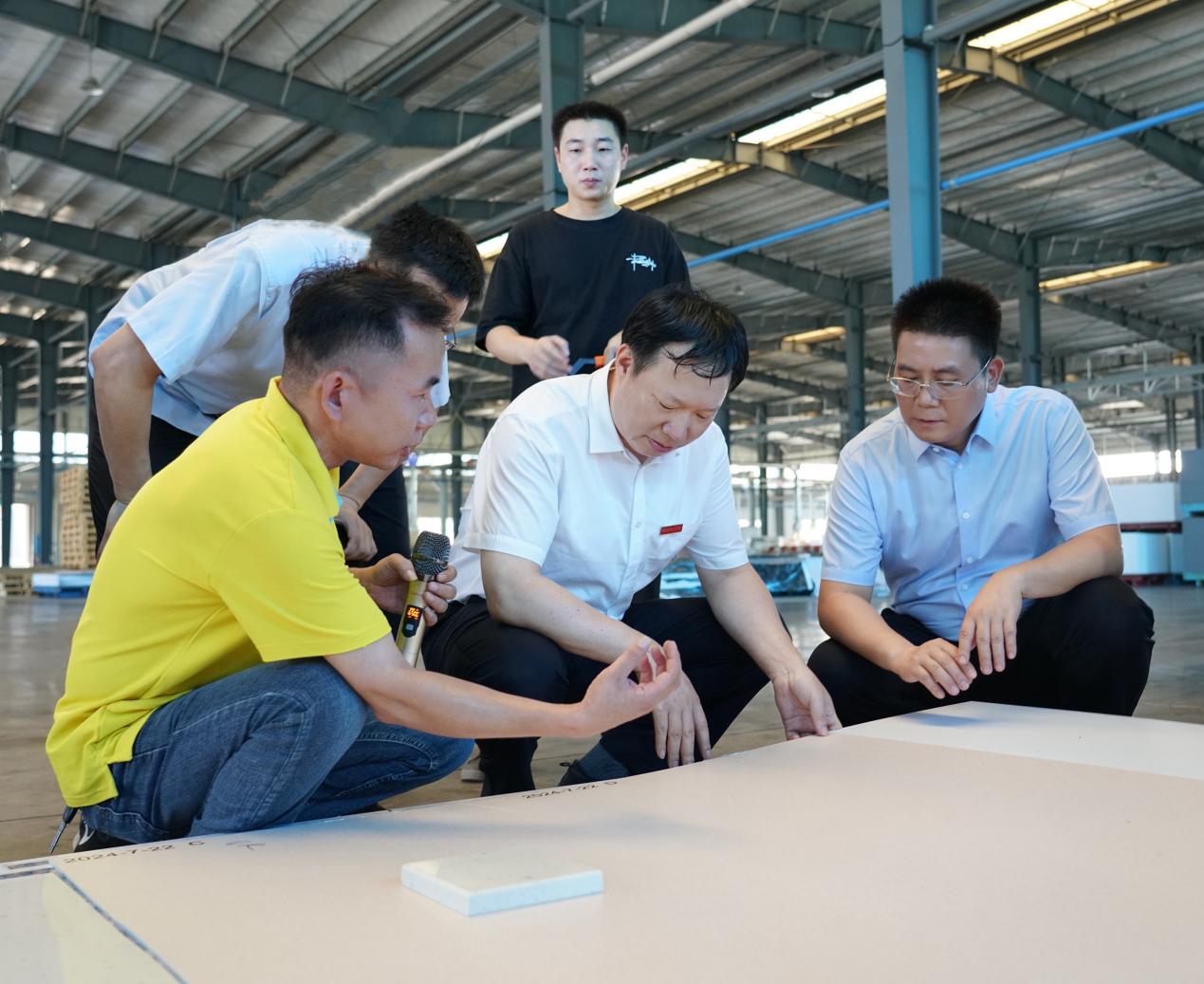
President Zeng Xiangjun leads a team to investigate in Yueyang County, promoting the implementation of industry-education integration projects.
Adjusting Majors According to Demand Through "Addition and Subtraction"
Entering the university’s "Gate of Hope," summer greenery grows freely. The newly established School of Energy and Electrical Engineering welcomes many freshmen, currently offering two undergraduate majors: Electrical Engineering and Automation, and New Energy Science and Engineering.
The power and new energy industry is one of Yueyang’s key industrial chains, with Yueyang aiming to build a comprehensive energy base in central China based on this industry. On July 3, 2024, the School of Energy and Electrical Engineering at HNIST was formally established, directly providing high-quality talent supply and scientific and technological achievement transformation for Hunan’s power and new energy industry. Disciplines and research follow the industry, and major settings revolve around demand.
Over the past five years, HNIST has boldly done "subtraction" in its major offerings, suspending enrollment and phasing out 21 undergraduate majors. At the same time, it has skillfully done "addition" by aligning with and adjusting to regional industrial chain layouts, successively adding 11 undergraduate majors such as New Energy Science and Engineering, Big Data Management and Application, Pharmacy, Artificial Intelligence, and Robotics Engineering.
Are these major adjustments made arbitrarily? Zeng Xiangjun explained that they are primarily based on identifying local industry demands for talent. For example, the newly added major in Optoelectronic Information Science and Engineering was established in response to the substantial talent demand from Hunan’s seven optoelectronic technology industrial parks.
In response to Hunan’s industrial development needs and the "new three" industries, HNIST has built eight characteristic professional clusters, including petrochemicals, electronic information, intelligent manufacturing, and port logistics. Each major is supported by industries and societal needs, further strengthening the alignment between the undergraduate major structure and regional economic and social development. HNIST’s Green Chemical Industry College was selected as a Hunan Modern Industry College, and its Modern Petrochemical Outstanding Engineers Training Base was included in Hunan’s first batch of engineer training bases.
In May 2024, at the graduate job fair held at HNIST, the industrial chain recruitment zone was particularly eye-catching. Forty-three enterprises offered 793 positions, all from Yueyang’s modern petrochemical, advanced equipment manufacturing, and modern agriculture and food processing industrial chains. Over the past five years, the proportion of the university’s graduates staying to work in Yueyang increased from 9.5% in 2019 to 19% in 2023, with the fastest-growing employment numbers coming from the manufacturing and information technology service industries.
"Promoting industry-education integration and science-education convergence, building disciplines and majors on industrial chains, accelerating the development of new quality productive forces, and serving local needs with university capabilities are both the era’s requirements for running education that satisfies the people and the inherent need for the high-quality development of local universities," said Zhang Guoyun.
(Editor: Yuan Xuan; Preliminary Review: Guo Yunfeng; Final Review: Si Nianwei)


Xueyuan Road, Yueyang City, Hunan Province, China